Recent Posts

Tuesday, June 18, 2013

Thunia marshalliana

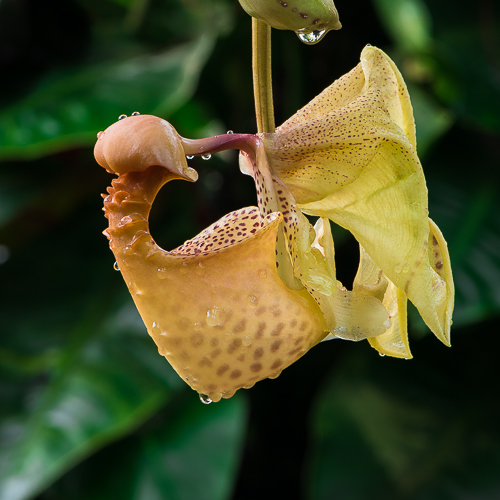
Here is a plant that deserves to be more widely grown: Thunia marshalliana, a terrestrial orchid from tropical Thailand, Myanmar and south China. An orchid which somehow manages to be big and delicate at the same time.

The flowers, whose petals have the texture and drooping aspect of a sheer handkerchief, are carried at the end of slender arching canes, and are thus best seen from below. For this reason, we grow ours in hanging baskets.

The flowers are big, about 5" across. Best of all is that orange trumpet of a lip, elaborately ridged and fringed. What great texture this flower has!

Thunia species are easy and terrifically rewarding to grow.

From mid-spring through autumn, while the plant is in leafy growth, we water frequently and thoroughly, and fertilize like mad. Like many orchids with a strongly seasonal growth cycle, thunias are heavy feeders, at least by orchid standards. Ours get 200 ppm 15-5-15 plus a top dressing of slow release fertilizer (the type that lasts four months) at half strength. The plants shed their leaves starting in October--our cue to gradually reduce our frequency of watering. The canes are bare for about three months, during which time we water maybe once every ten days. In late March, new leafy shoots emerge. When they are about the length of my index finger, it's time to start watering and feeding again.

Mature canes produce keikis (baby plantlets) at their ends, so it's super simple to make more thunias.

So, why are Thunia species so hard to find commercially? I don't know! I think it's time for a revival of this fantastic orchid.

Tuesday, June 4, 2013

Laelia Trios

Laelia purpurata var. werkhauseri
Long days are the best thing about summer, as far as I'm concerned. (Sunrise at 6 am, at last! Daylight until 9 pm!) Long days and Laelia purpurata.

Laelia purpurata var. carnea
Laelia purpurata varieties (and there are lots) are outstanding in every way: easy to grow; magnificent on display. In a contest between Laelia and Cattleya, Laelia gets my vote, every time.

Laelia purpurata adores heat and very bright light. So if you're living in the Pacific Northwest, or in a cavern-like dwelling, maybe they're not the plant for you. But if you excel at cattleyas, whether in a greenhouse or indoors, and can find a slightly warmer, brighter microclimate in your growing area, you really need to be growing laelias. They are that awesome.

Our favorite Laelia sources include Tropical Orchid Farm (HI), Carter & Holmes (SC), and Andy's Orchids (Andy, located in Encinitas, California, excels in Laelia species from the cooler, drier Mexican highlands).


Thursday, May 30, 2013

Catasetum Orchidglade

It's June. Well, almost. June is the unofficial start of Catasetum season and our Catasetum fans are rejoicing (hi Tracy!).

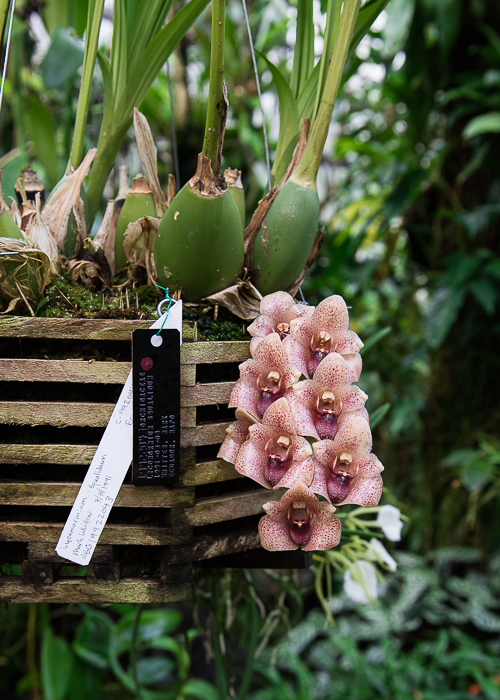
Castasetums are the most interactive of orchids. In the center of each male flower is a downward-pointing trigger lever (visible in the photo above). When the trigger is bumped by a pollinator, or pressed by a finger (please don't do this, as the flower dies immediately, ruining the display for future visitors), the pollen masses (pollinia) are flung outward. Check out this video to watch this in action. The intended recipient is a male Euglossine bee. But the pollinarium (pollinia plus adhesive disk) will also adhere tenaciously to a pencil, finger, forehead, whatever. It will emerge intact from the laundry, still clinging to a T shirt. Stop by and see them in the Orchid Display House this summer.


Dendrobium wardianum

Dendrobium wardianum
Arriving at the end of the great tidal wave of dendrobiums in April and May is Dendrobium wardianum. Is this our prettiest Dendrobium? Sometimes I think so.

Dendrobium wardianum flowers on leafless canes after a month or so of cool dry weather, just like Dendrobium anosmum. In fact, we grow them exactly the same way. It spends the summer in our warm shady tropical greenhouse, and then part of the winter in our 53º (night minimum) sunny greenhouse. Dendrobium wardianum grows as an epiphyte from southern China through southeast Asia.


Sobralia callosa and Friends

Welcome to another Sobralia Day. Every few weeks you can walk into the Orchid Center and find lots of sobralias covered with flowers. Some horticulturists claim that a cold snap will trigger a mass flowering. Nah. I'm sure sobralias arrange these events in advance, telepathically. The flowers of most Sobralia species last just one day.

Sobralia callosa
On my list of Top Ten Sobralias, Sobralia callosa ranks high in the top two. It is tiny, a highly prized quality in a group of orchids that mostly aspire to be Hydrangeas -- oversized and floppy, spilling over into their neighbor's space. A mature Sobralia callosa spans 1 ft. from tip to tip. I wish we had a hundred of them.

unidentified white Sobralia
Our unidentified (very tricky, those white Sobralias) Sobralia is more typical --a 6' adolescent.

Sobralias are native to Central and South America, where you can sometimes see them in flower, growing on steep road cuts in full sun.

Friday, May 24, 2013

Coryanthes macrocorys


In case you were starting to think (based on my photos thus far) that all Coryanthes (Bucket Orchid) flowers are huge and grotesque, meet Coryanthes macrocorys. Above is a half opened flower, its spotted sepals reflexed backwards like angel wings.


Thursday, May 23, 2013

Coryanthes macrantha buds

The Fuqua Orchid Center is a garden of surprises. I walked into the greenhouse early yesterday morning and came face to face with the pinched and furrowed face of a Coryanthes macrantha (Bucket Orchid) bud. The light was dim and I think I jumped.

For sheer bud awesomeness, nothing beats Coryanthes.  A Coryanthes labors for weeks to produce two enormous buds. Those buds become the most riveting objects in the entire greenhouse. What's inside? 

Coryanthes macrantha
You can see Coryanthes macrantha on display this week in the Fuqua Orchid Center's Orchid Display House.


Wednesday, April 17, 2013

How to Grow Phalaenopsis

  • Light 80% shade in a greenhouse or an unobstructed east windowsill at home.
  • Temperature Warm. 64º night minimum. 85º daytime maximum.
  • Humidity 80%
  • Water Water thoroughly when the top 1" of medium is lighter in color
  • Fertilizer 1/4 to 1/2 strength balanced fertilizer applied every 2 weeks.
  • Rest Period None.
  • Growing Medium Premium sphagnum or Fir bark+ charcoal+ perlite+peatmoss mix.
  • When to Repot After flowering.
  • How Often to Repot When the plant has outgrown its pot OR when the medium has broken down. A good quality medium will last about two years.
  • How to Re-bloom Phal hybrids need a strong root system, sufficient light intensity and daytime temperatures below 78º in order to re-bloom.


Related Posts Plugin for WordPress, Blogger...