Recent Posts

Showing posts with label Euglossine bee pollinated orchids. Show all posts

Friday, September 20, 2019

Another Fantastic Bucket Orchid

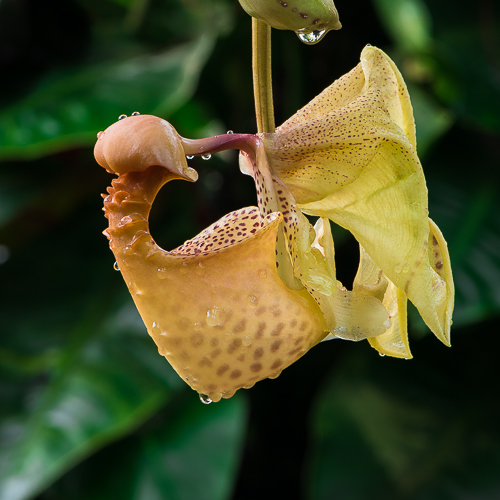
Our magnificent Coryanthes bruchmülleri has been flowering regularly since it reached maturity last summer. C. bruchmülleri is the Goliath of the genus, with flowers four to five inches in diameter.
Coryanthes bruchmülleri grows in lowland wet forests near the border of Colombia and Venezuela. In the wild, Coryanthes are typically found growing in ants' nests in a mutualistic relationship with the ants. It's not uncommon to read that Coryanthes are difficult to cultivate, perhaps lacking something provided in nature by the ants. In our greenhouses, without ants, they are no more difficult than any other member of the Stanhopeinae, provided you can exclude the slugs and bush snails that consume the roots and new shoots. Our tactics: frequent repotting, applications of diatomaceous earth, and eliminating the source of new introductions -principally orchids from Hawaii. I'm happy to report that we've got a capsule gestating on one of our plants. It will be terrific to get this fantastic species in production.

Tuesday, April 2, 2019

Now opening: Coryanthes macrantha

We've produced a bumper crop of Coryanthes seedlings that are now reaching flowering size. Coryanthes, with their provocative morphology and intense fragrances are simply the best teaching tool ever for introducing students (or anyone!) to orchid pollination concepts, and Euglossine bee pollination in particular. But, since the flowers only last about three days, a large number of plants are needed for a continuous display.

We are very fortunate to have a mircro prop lab to allow us to produce orchid seedlings. Coryanthes are somewhat weedy in the sense that they reproduce rapidly. They have a very short capsule maturation (60 days), produce copious quantities of seed and robust, fast growing, fast flowering seedlings.

After they outgrow the plug stage, our Coryanthes seedlings grow best on vertical mount, rather than in a pot or basket. Tree fern slabs have worked well for us, but last year, in an attempt to wean ourselves from our tree fern dependency, we tried a new slab material: coarse filter media, borrowed from our aquarium colleagues.

Filter media isn't a good choice for every orchid, but the Coryanthes love it. Within a couple of months, their roots completely fill the interior spaces of the slab.

We are super excited to have more of these fascinating orchids on display for you to see. Look for them this year in the Orchid Display House!

Wednesday, May 23, 2018

Polycycnis muscifera

Some of our wonderful Polycycnis species are flowering this month. Polycycnis is a genus of Euglossine bee pollinated orchids in the Stanhopeinae native to Central and South America. The flowers are small and delicate with a graceful arching column (reminiscent of Cycnoches, with whom they share a name derived from the Latin root cycnis, meaning swan). All the Polycycnis species have labella that are to some degree hairy. I'm amazed that any insect would regard the extraordinary velcro lip of Polycycnis muscifera (above) an enticing landing platform. Those long hairs must act as a flag to attract the bee's attention to the landing field.

Like other Euglossine bee pollinated orchids, Polycycnis offers fragrance compounds as a reward to male Euglossine bees. The bee lands on the lip and starts scratching near the base in order to obtain the fragrance volatiles. The weight of the bee pulls the flower down. When the bee starts hovering to transfer the fragrance to his hind legs, the flower's sticky viscidium disc, which you can see above in profile projecting like a tab from the club-like column, attaches to the bee's thorax.

Polycycnis are not at all common in cultivation, so be sure to stop by and catch ours in flower!


Tuesday, March 13, 2018

Hey, Who Turned My Peristeria Yellow?

This was a surprise. The sort of thing that happens in your dreams (especially if you are a plant breeder), but only rarely in real life: a novel color form in a batch of seedlings.

Last August, Ron Determann and I scooped up a handful of nearly identical, near-blooming-sized Peristeria guttata seedlings at Carter & Holmes. Peristerias other than elata are not common in the trade so I was delighted to add some fresh genetic stock to our two existing accessions of guttata.  Naturally, I expected them to be the typical color form, white with red spots. Pictured above is one of the siblings which flowered in January. About two weeks ago, I noticed that one of the others had unusually light colored buds.

Apart from this surprising event, it seems like the genus Peristeria is in need of some taxonomic work. In our own collection of Peristeria, we have at least one individual whose identity is suspect, but the literature on Peristeria is pretty thin. In the mean time, I've selfed our yellow accession (with some of the future offspring earmarked for Mac Holmes). My experience selfing our peristerias cautions me that we've got maybe a 50/50 chance of a successful outcome -Peristeria capsules resulting from selfings often abort part way through their development.

Monday, July 17, 2017

Pollinating Lycomormium

It's been a good month for Lycomormium here. This species has been flowering for three weeks, jostling for attention among the fiskei baskets in the Orchid Display House. Since we haven't yet produced seedlings from any of our Lycomormium species, this month presented a terrific opportunity to get some capsules on our plants.

Unfortunately, Lycomormium is incredibly difficult to pollinate using pollinia fresh from the anther cap. The yellow pollinia are like twin balloons that resist being stuffed into the narrow opening of the stigmatic cavity. Darwin described the same problem pollinating Gongora in On the Various Contrivances by Which Orchids Are Fertilized by Insects. His solution was to let the pollinia dry for five hours, with the rationale that the pollinia attached to an insect would dry and shrink as the insect foraged.

So, taking my cue from Darwin, I removed the pollinarium with its sticky disk from the anther cap using a pencil, and then slapped it onto the surface of the dorsal sepal. No worries about it coming loose. Pollinaria have emerged intact on my clothing after a trip through the washer and dryer at home. The photo above was taken after two days of drying in the greenhouse. You can see that the yellow pollinia have deflated and become concave after dehydrating. Pollination was easy after that.

In other Stanhopeinae, like Gongora maculata, the stigmatic cavity doesn't open sufficiently until the day after the pollinia are removed (Dodson AOS Bulletin Vol. 31 No.8). Changes in the size and shape of the pollinia and stigmatic opening make it unlikely that the bee removing the pollinia from an orchid will also pollinate it, and are important mechanisms in preventing self pollination.

Though we've had this accession for a while, it has remained Lycomormium sp. in our database since it has floral characteristics of both schmidtii and squalidum. A number of possible explanations exist, but it seems more work needs to be done on this genus. On the subtribal level LycomormiumPeristeria and Coeliopsis have traditionally been placed in the Stanhopeinae, but more recently Whitten, Williams and Chase (2000) have grouped them together in the Coeliopsidinae based on molecular and morphological evidence.

Wednesday, June 21, 2017

In the Orchid Display House

Lycomormium fiskei ABG 19960924
Maybe it's the color -a true pink, without any of the red violet characteristic of so many 'pink' orchids -that makes Lycomormium fiskei so striking. And the size. Lycomormiums are hefty plants. Our plants, which are relatively small divisions of three or four pseudobulbs, measure three feet in height and must weigh 10 lbs each, basket included. The pendant inflorescence makes an open sided basket pretty much required for producing flowers on a Lycomormium.

Lycomormium fiskei ABG 19960924
Our lycomormiums have big waxy flowers and a strong sweet fragrance like many orchids pollinated by male Euglossine bees. They resemble the closely related Peristeria  -another genus with plicate leaves and smooth pseudobulbs -except for Lycomormium's immobile lip.

Lycomormium, Peristeria and Coeliopsis were for many years placed in the subtribe Stanhopeinae, but differ morphologically in having smooth ovoid pseudobulbs with 3-4 leaves, globose flowers, root hairs, a round viscidium adapted for attachment closer to the bee's head, a column foot, and the absence of a floral abscission layer allowing the flowers to fall off after they wither. Based on these morphological differences and on molecular analysis supporting the idea of two sister taxa, Whitten, Williams and Chase (2000) favor recognizing separate subtribes, Coeliopsidinae and Stanhopeinae.

Friday, September 9, 2016

Bullish on Stanhopeas

Stanhopea hernandezii
For a long time I thought of Stanhopea hernandezii as a sort of junior sized version of Stanhopea tigrina, that mastodon of the stanhopeas. Both give the impression of a massive cranium and formidable tusks. But it wasn't until this summer when we flowered both species simultaneously that I was able to compare them side by side.
Stanhopea tigrina
In profile, it's easy to see that the the bottom of the hypochile is rounded like a bowl in hernandezii, but flattened in tigrina.
Stanhopea tigrina, a second color form
Stanhopea hernandezii, dorsal view
The horns are round in cross section and slender in hernandezii, but flattened and broad near the base in tigrina.
Stanhopea tigrina, dorsal view
Stanhopea hernandezii, lip and column
Notice the striking difference in the columns of the two species: hernandezii's narrow column compared with tigrina's broadly winged column.
Stanhopea tigrina, lip and column
Stanhopea hernandezii, lip
With the column removed you can see how much broader the epichile is in tigrina than in hernandezii.
Stanhopea tigrina, lip
Stanhopea hernandezii, lip in ventral view
Stanhopea tigrina, lip in ventral view
Stanhopea hernandezii, column
Stanhopea tigrina, column
Stanhopea hernandezii and tigrina are both endemic to Mexico. S. hernandezii occurs on the southwestern slopes of the Mexican plateau at about 1,600 to 2,000 meters elevation in the states of Morelos, Mexico and Michoacan. I can't find referennce to a specific pollinator for hernandezii. The largest fragrance components measured by Gerlach (in Lankesteriana 2010) are cinnamyl acetate (64%) and benzyl acetate (11%).

Stanhopea tigrina is known from  the eastern slopes of the plateau at about 1200 to 1800 meters in the states of Tamaulipas, Hidalgo, Puebla and Vera Cruz. Its pollinator is Euglossa viridissima. The chocolate fragrance described so often in the literature (but which I cannot discern in our plants) derives from the combination of phenylethyl-acetate, a primary component of the fragrance, and vanilline, one of the secondary components, according to Rudolf Jenny.

Our S. hernandezii, which we received from a commercial nursery as S. ecornuta, flowered in August and probably won't be on display again until next summer. On the other hand, we have quite a few S. tigrina in our collection. The flowers only last about three days, but it's definitely worth stopping by to try to catch them when they flower in August and September. They are magnificent.

Sunday, July 31, 2016

Catasetum expansum x 3

In the stranger-than-fiction world of Catasetum flowers -where male and female flowers look so different that they were once classified as different species, and male flowers fire their pollen like missiles -it is the male flowers that are the peacocks and warrior princes with bold colors, sometimes elaborately fringed, toothed or spotted. Male Catasetum expansum flowers have an especially large shield shaped lip. In the center of the lip is a cavity, like a truncated spur, with thick fleshy walls. The cavity doesn't secrete nectar like a spur, but is a source of fragrance for fragrance-collecting Euglossine bees.

This week in our back up greenhouses, we have three different color forms of male Catasetum expansum flowers. First in this regiment is a handsome olive color form with a blood red center and plenty of red war paint. Release of the pollen masses is triggered by a touch to the downward pointing bristle in the center. In the photo above, notice that the flower in the upper left corner still has its pollen payload, while the flower in the center has already fired its two pollen masses.

Our second color form has pale green petals and sepals against a rich yellow-gold lip.

The most common form in our collection is a soft mint nonpareil color, to my eye the most soothing of the three. Catasetum expansum has a surprising range of color forms for a species with a relatively small distribution -northeastern Ecuador, where it grows as an epiphyte in seasonally dry forests from sea level to 1500 meters elevation.

Sunday, July 17, 2016

Summer Orchid Fragrances

It is fascinating to observe all the different ways in which visitors and staff like to experience the orchids here. Many people like to experience the flowers through the lens of their camera, lingering on visual details. Others visit each and every flower, inhaling deeply. For connoisseurs of fragrance, summer is without a doubt the best time to visit the Orchid Center. Here are a few of the best this week.

Phalaenopsis bellina is perhaps the most fragrant of the moth orchid species. "Fruit Loop orchid" is the common name suggested by Eric Christenson, the taxonomist who separated bellina from the closely related violacea on the basis of fragrance and morphological differences. Its fragrance is blend of many compounds, including geraniol, which has a rose-like scent attractive to bees; and linalool, a floral/spicy fragrance. The quantity and quality of an orchid fragrance can be dependent on the time of day, and you may notice that our bellina seedlings are almost scentless in the early morning and very fragrant later in the day.

Anguloa uniflora, one of our tulip orchid species, smells like wintergreen, an unexpected but wonderful pairing. Wintergreen is the fragrance associated with methyl salicylate, a volatile compound that is a common component in floral fragrances that attract male Euglossine bees. The composition of the fragrance of an orchid species can vary from plant to plant to a striking degree. If you take a moment to smell several of our unifloras, you will notice that one of our accessions produces an especially powerful wintergreen fragrance, the others less so.

I'm not going to talk about the slug who brazenly made his way to the top of a floral bract while I was composing this shot, except to say that he is no longer with us.

Anguloa virginalis has a sweet, but somewhat medicinal fragrance composed of 1.8-cineole, limonene, myrcene and pinene. By mid afternoon, our three plants can fill the back of the High Elevation House with an invisible fragrance plume.

Peristeria lindenii was here and gone in a flash typical of short-lived Stanhopeinae flowers, but with a complex fragrance unlike any other I that I know of -like a fruit salad over a layer of eucalyptus (cineole).

The practice of dipping your nose in every beautiful orchid flower will eventually yield a bad result. Lovely though it is, Bulbophyllum echinolabium produces the kind of stench that might make you think about alerting the Public Health Department, but only when you get really close. It reels in unsuspecting people the same way it would lure a fly, with brilliant red colors and long wafting sepals, until nose meets flower, then there are cries of outrage and indignation. Don't say I didn't warn you.


Sunday, July 10, 2016

Stanhopea costaricensis

July is just a little early for stanhopeas here. It will be another month before the flooodgates open. In the meantime, we had a magnificent Stanhopea costaricensis in flower in the Orchid Display House last week. The fragrance was just wonderful, with a hint of vanilla.

Our Stanhopea costaricensis  has deep red splashes of varying sizes on the lip and column and some fascinating leopard spots on the petals and sepals.

It's flower isn't quite as big as the really big boys- Stanhopea tigrina, embreei and platyceras, but big enough that I had to back the camera way up in order to get the entire flower and pedicel in the frame.

Seen from above, the elongated lip has a diamond shaped hypochile.

The column has prominent wings.

Stanhopea costaricensis grows as an epiphyte in Central America between 500 and 1500 meters elevation. It grow without any problems in our intermediate greenhouse (60º night minimum) in 60% shade. And it makes an impressive specimen sized (12") basket with outstandingly fragrant flowers.

Related Posts Plugin for WordPress, Blogger...