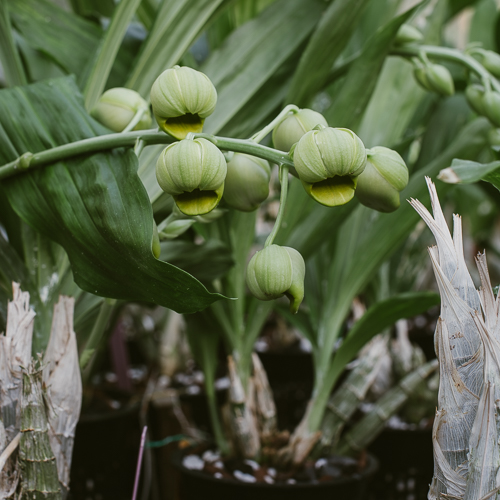
Maybe it's the color -a true pink, without any of the red violet characteristic of so many 'pink' orchids -that makes Lycomormium fiskei so striking. And the size. Lycomormiums are hefty plants. Our plants, which are relatively small divisions of three or four pseudobulbs, measure three feet in height and must weigh 10 lbs each, basket included. The pendant inflorescence makes an open sided basket pretty much required for producing flowers on a Lycomormium.
Our lycomormiums have big waxy flowers and a strong sweet fragrance like many orchids pollinated by male Euglossine bees. They resemble the closely related Peristeria -another genus with plicate leaves and smooth pseudobulbs -except for Lycomormium's immobile lip.
Lycomormium, Peristeria and Coeliopsis were for many years placed in the subtribe Stanhopeinae, but differ morphologically in having smooth ovoid pseudobulbs with 3-4 leaves, globose flowers, root hairs, a round viscidium adapted for attachment closer to the bee's head, a column foot, and the absence of a floral abscission layer allowing the flowers to fall off after they wither. Based on these morphological differences and on molecular analysis supporting the idea of two sister taxa, Whitten, Williams and Chase (2000) favor recognizing separate subtribes, Coeliopsidinae and Stanhopeinae.
Recent Posts
Showing posts with label June flowering orchids. Show all posts
Wednesday, June 21, 2017
Tuesday, July 12, 2016
The Greens of Summer
Posted by
Becky Brinkman
First is a real stunner. Clowesia russelliana is a frothy extravaganza of icy mint green flowers. If you look closely, you can see a touch of pink in the petals and sepals.
It produced far and away the best fragrance of the week -a wonderful mixture of vanilla, ginger and eucalyptus.
Male Catasetum pileatum flowers are a gorgeous creamy green. It's not very often that we produce female flowers (on the left) and male flowers (on the right) simultaneously on a Catasetum, so I was quick to get a capsule on this plant.
Notice the subtle chartreuse tinge on the lip of these truffle-shaped Catasetum luridum flowers.
The glossy lip of Catasetum expansum looks as though it has been dipped in egg yolk.
One of the pleasures of walking through the Orchid Display House is discovering a delightful color combination. Lycaste oculata with its kiwi green sepals and pure white petals seems to my eye to be the perfect summer pairing of colors. It's a shame that the greens are often overlooked. Be sure not to miss them on your next visit to the Fuqua Orchid Center.
Saturday, July 2, 2016
Two Miniatures
Posted by
Becky Brinkman
Two of our miniature orchids are generating a lot of excitement this week. Dyakia hendersoniana, all of five inches tall, has the kind of electric fuchsia coloring that is visible across the greenhouse.
Dyakia hendersoniana grows as an epiphyte in primary and old secondary forests from 0 to 700 meters elevation in areas of high rainfall on the island of Borneo. The column and lip are white, and the lip has an elongated spur.
Since my reference states that this is now a very rare species and endangered in the wild, I took this minute specimen to my office for pollinating. Tiny orchid flowers with spurs are (for me at least) one of the supreme challenges in orchid pollination. Removing the tiny anther cap and maneuvering the two pollinia into the stigmatic cavity without dropping them into the spur or onto my desk requires enormous patience and a steady hand. Usually, after I've dropped a few and I finally have the pollinia correctly positioned, they perversely refuse to release from the tip of my pencil. I am, as ever, amazed that insects can effortlessly accomplish this.
Pleurothallis tripterantha makes a perfect tiny specimen plant with pendant chains of honey colored flowers. It is an undemanding little plant that seems to always be in flower (perfect, in other words). We grow our plant in an intermediate temperature greenhouse in 80% shade. Pleurothallis tripterantha is widely distributed from Costa Rica through northern South America in wet montane forests at 900 to 2700 meters elevation.
Dyakia hendersoniana grows as an epiphyte in primary and old secondary forests from 0 to 700 meters elevation in areas of high rainfall on the island of Borneo. The column and lip are white, and the lip has an elongated spur.
Since my reference states that this is now a very rare species and endangered in the wild, I took this minute specimen to my office for pollinating. Tiny orchid flowers with spurs are (for me at least) one of the supreme challenges in orchid pollination. Removing the tiny anther cap and maneuvering the two pollinia into the stigmatic cavity without dropping them into the spur or onto my desk requires enormous patience and a steady hand. Usually, after I've dropped a few and I finally have the pollinia correctly positioned, they perversely refuse to release from the tip of my pencil. I am, as ever, amazed that insects can effortlessly accomplish this.
Pleurothallis tripterantha makes a perfect tiny specimen plant with pendant chains of honey colored flowers. It is an undemanding little plant that seems to always be in flower (perfect, in other words). We grow our plant in an intermediate temperature greenhouse in 80% shade. Pleurothallis tripterantha is widely distributed from Costa Rica through northern South America in wet montane forests at 900 to 2700 meters elevation.
Tuesday, June 28, 2016
Anguloa cliftonii
Posted by
Becky Brinkman
Even if it weren't scented like an ice cream sundae, this pale yellow tulip orchid with red marbled petals and gracefully curved sepals would still be one of our most striking species. But best of all is what's hidden inside.
As I unwrapped the layers of sepals and petals, the sight of the lip actually made me laugh.
All anguloas have a hinged lip to facilitate pollination, but cliftonii's lip has something special in the way of ornamentation.
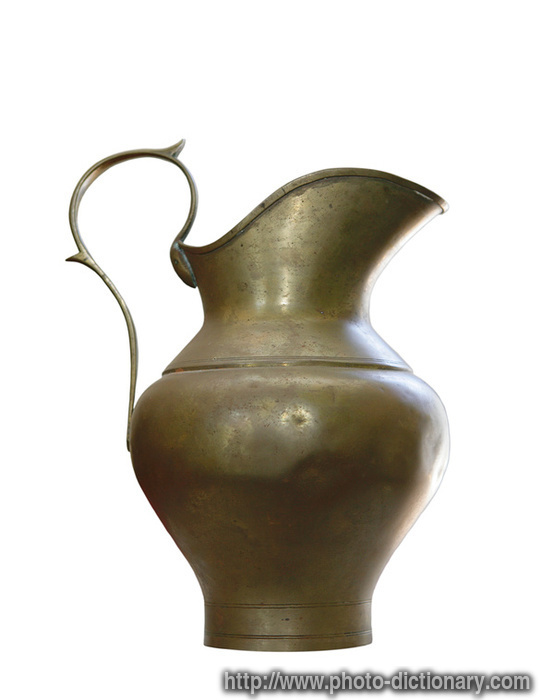
The lip is a miniature bowl with flared edges, and its ornate apex arches backwards as Henry Oakeley writes in his book Lycaste, Ida and Anguloa, "like the handle of a ewer." Ewer?
That sent me on a Google search. Above is the lip rotated 180º and flipped horizontally, looking like a tiny pitcher with a handle, a ewer. How cool is that?
The apex of the lip is the source of the fragrance, which is highly attractive to at least one species of Euglossine bees. It is angled toward the column, so that the bee's weight causes it to tilt toward the anther cap and pollinarium. Upon contact the pollinarium is attached to the bee's abdomen.
Our tulip orchids are off to a slow start this summer, but I expect there will be many for you to see in the Orchid Display House in July. They are wonderful!
As I unwrapped the layers of sepals and petals, the sight of the lip actually made me laugh.
All anguloas have a hinged lip to facilitate pollination, but cliftonii's lip has something special in the way of ornamentation.
The lip is a miniature bowl with flared edges, and its ornate apex arches backwards as Henry Oakeley writes in his book Lycaste, Ida and Anguloa, "like the handle of a ewer." Ewer?
That sent me on a Google search. Above is the lip rotated 180º and flipped horizontally, looking like a tiny pitcher with a handle, a ewer. How cool is that?
The apex of the lip is the source of the fragrance, which is highly attractive to at least one species of Euglossine bees. It is angled toward the column, so that the bee's weight causes it to tilt toward the anther cap and pollinarium. Upon contact the pollinarium is attached to the bee's abdomen.
Our tulip orchids are off to a slow start this summer, but I expect there will be many for you to see in the Orchid Display House in July. They are wonderful!
Monday, June 13, 2016
A Vanilla Scented Tulip Orchid
Posted by
Becky Brinkman
Vanilla was not what I was expecting to smell yesterday when watering the Anguloa bench. If anything, I would have expected some foetid smells from the adjacent Nepenthes, quietly digesting their insect soup. Vanilla just isn't a fragrance I associate with Tulip Orchids. But no mistake, a little searching among the big accordion pleated leaves brought me to this guy, Anguloa cliftonii. At close range the fragrance was the familiar camphor/cineole common to many Euglossine bee fragrances, but with sweet overtones of vanilla. This is only the second time we have flowered cliftonii. Either I wasn't paying attention last time, or I caught it at the wrong time of day. What a treat.
Sunday, June 5, 2016
Sunday Morning in the Orchid Center
Posted by
Becky Brinkman
We rotate weekend watering and it's generally a mad two hour rush to finish before the doors open at 9 am, so there's not much time for picture taking. This morning, however, I was determined, and grabbed my camera while the ponds were filling. Of course the laelias had to have their pictures taken first.
A flush of flowers and new shoots on Lycaste consobrina glowed in the early light. They are growing nicely in the crevices of rocks in our Mexico bed.
Paphiopedilulm superbiens has an enormous plum colored pouch that makes the petals look small by comparison.
One of our best kept secrets: Ionbulbon munificum. If the flowers aren't cool enough for you, check out the shaggy pseudoboulbs.
That long fringe of fibers just slays me. I'm completely smitten with this plant.
The acinetas are still coming on strong. They are beautiful, though none has a fragrance that can match the sweetest of the stanhopeas. Acineta mireyae looked lovely with a backdrop of glass sculptures by Dale Chihuly.
A cloud of Oncidium phymatochilum flowers floated above the pathway. We have about 50 seedling offspring of this plant approaching flowering size in the back up greenhouses. They will make a nice show next summer.
The (unsprung!) trigger hair in the center of the Catasetum expansum flower was ready for action. The flowers have a fragrance that no perfumer will ever bottle: dill pickles and spearmint.
June is a terrific month to visit the Fuqua Orchid Center. Stop by and see us!
A flush of flowers and new shoots on Lycaste consobrina glowed in the early light. They are growing nicely in the crevices of rocks in our Mexico bed.
Paphiopedilulm superbiens has an enormous plum colored pouch that makes the petals look small by comparison.
One of our best kept secrets: Ionbulbon munificum. If the flowers aren't cool enough for you, check out the shaggy pseudoboulbs.
That long fringe of fibers just slays me. I'm completely smitten with this plant.
The acinetas are still coming on strong. They are beautiful, though none has a fragrance that can match the sweetest of the stanhopeas. Acineta mireyae looked lovely with a backdrop of glass sculptures by Dale Chihuly.
The (unsprung!) trigger hair in the center of the Catasetum expansum flower was ready for action. The flowers have a fragrance that no perfumer will ever bottle: dill pickles and spearmint.
June is a terrific month to visit the Fuqua Orchid Center. Stop by and see us!
Wednesday, June 17, 2015
The Wolf's Head
Posted by
Becky Brinkman
The sweet spicy fragrance that hits you upon entering the Orchid Display House comes from this plant, an unnamed Lycomormium species. It is a complex fragrance. To my uneducated nose, it's nutmeg and camphor. An unconventional pairing to me, but appealing to male Euglossine bees, who as pollinators, are entitled to their preferences.
All of the Lycomormium species in our collection are hefty plants when mature, with long (3 ft.) accordion-pleated leaves. Like Stanhopea and Acineta, two other members of the orchid subtribe Stanhopeinae, Lycomormium species produce pendant spikes that grow down through the substrate, so we grow our plants in slatted baskets to allow the spikes to emerge.
So, what's up with the name Lycomormium? Lykos (wolf) and mormo (ghost) is an intriguing combination. Pedro Ortiz, in 'Orchids of Colombia', says that when seen from the front, the column appears to have a pair of teeth projecting from under the anther, giving it the look of a wolf's head. Reichenbach, who named this genus, must have been looking at a type specimen of L. squalidum with more impressive teeth than our species possesses.
If you're not a Euglossine bee, a Lycomormium can be a right pain to pollinate -like trying to stuff a fat pair of rabbit's ears into a mail slot. It seems to be easier if the flower has been without its anther cap for a day. We grow our plants in a mixture of long-fibered sphagnum and chopped coarse tree fern fiber. A couple of years ago we relocated our Lycomormium baskets to a brighter cooler location next to the wet wall in our back up greenhouses, with good results -stronger plants and more inflorescences.
All of the Lycomormium species in our collection are hefty plants when mature, with long (3 ft.) accordion-pleated leaves. Like Stanhopea and Acineta, two other members of the orchid subtribe Stanhopeinae, Lycomormium species produce pendant spikes that grow down through the substrate, so we grow our plants in slatted baskets to allow the spikes to emerge.
So, what's up with the name Lycomormium? Lykos (wolf) and mormo (ghost) is an intriguing combination. Pedro Ortiz, in 'Orchids of Colombia', says that when seen from the front, the column appears to have a pair of teeth projecting from under the anther, giving it the look of a wolf's head. Reichenbach, who named this genus, must have been looking at a type specimen of L. squalidum with more impressive teeth than our species possesses.
If you're not a Euglossine bee, a Lycomormium can be a right pain to pollinate -like trying to stuff a fat pair of rabbit's ears into a mail slot. It seems to be easier if the flower has been without its anther cap for a day. We grow our plants in a mixture of long-fibered sphagnum and chopped coarse tree fern fiber. A couple of years ago we relocated our Lycomormium baskets to a brighter cooler location next to the wet wall in our back up greenhouses, with good results -stronger plants and more inflorescences.
Monday, June 8, 2015
June Openings
Posted by
Becky Brinkman
Ah, summer. June is a terrific month to visit the Orchid Center because of the large number and variety of orchids in our permanent collection that are flowering. The Laelia purpurata varieties are the undisputed stars of this month. But there are lots of others.
A perfectly formed Paphiopedilum acmodontum slipper fresh from its morning shower. This seedling is flowering for the first time this year. It has lovely mottled foliage. Acomontum is native to the Philippines.
This Lycomormium species has thick waxy flowers with a sweet spicy fragrance.
Pink and jade. Paphiopedilum liemianum is a Sumatran species that is easy to confuse with P. chamberlainianum and P. glaucophyllum, but is immediately distinguished by its leaf margins, which have short stiff hairs. It grows on limestone at 600 to 1000 meters elevation according to Phillip Cribb. I like the balletic positioning of the petals on this plant.
Lots of orchid excitement this month. Stop by and bring your camera!
A perfectly formed Paphiopedilum acmodontum slipper fresh from its morning shower. This seedling is flowering for the first time this year. It has lovely mottled foliage. Acomontum is native to the Philippines.
This Lycomormium species has thick waxy flowers with a sweet spicy fragrance.
Pink and jade. Paphiopedilum liemianum is a Sumatran species that is easy to confuse with P. chamberlainianum and P. glaucophyllum, but is immediately distinguished by its leaf margins, which have short stiff hairs. It grows on limestone at 600 to 1000 meters elevation according to Phillip Cribb. I like the balletic positioning of the petals on this plant.
Friday, June 21, 2013
Dichaea glauca
Posted by
Becky Brinkman
Glaucous. It means blue-grey. It describes the powdery patina on barely ripened plums and concord grapes; a surface you could etch your name on.
When I think of plants with glaucous leaves, the first that leaps to mind is Colorado Blue Spruce. Overused in the midwestern landscape, it has become an object of scorn and derision. Something you wouldn't be caught dead planting in your front yard. A synonym for tacky.
Let's not be snobs. I love glaucousness. Especially on an orchid as exquisite as Dichaea glauca. The plant, above, is maybe 18" tall (robust for a Dichaea), with a dusting of frost on its blue green leaves. It looks like it belongs in our chilly High Elevation House, though, in fact, it grows at intermediate elevations in nature, from Mexico through Central America, and would grow just as well in a humid greenhouse running coolish intermediate (58º nights) temperatures. Andy Phillips of Andy's Orchids grows magnificent Dichaea glauca plants in his southern California greenhouse. (I have a serious case of climate-envy for greenhouses in that region). In the FOC it loves growing in a mound of live sphagnum with its roots attached to a rocky surface. Our plants are flowering this month in the Tropical High Elevation House.
When I think of plants with glaucous leaves, the first that leaps to mind is Colorado Blue Spruce. Overused in the midwestern landscape, it has become an object of scorn and derision. Something you wouldn't be caught dead planting in your front yard. A synonym for tacky.
Let's not be snobs. I love glaucousness. Especially on an orchid as exquisite as Dichaea glauca. The plant, above, is maybe 18" tall (robust for a Dichaea), with a dusting of frost on its blue green leaves. It looks like it belongs in our chilly High Elevation House, though, in fact, it grows at intermediate elevations in nature, from Mexico through Central America, and would grow just as well in a humid greenhouse running coolish intermediate (58º nights) temperatures. Andy Phillips of Andy's Orchids grows magnificent Dichaea glauca plants in his southern California greenhouse. (I have a serious case of climate-envy for greenhouses in that region). In the FOC it loves growing in a mound of live sphagnum with its roots attached to a rocky surface. Our plants are flowering this month in the Tropical High Elevation House.
Thursday, June 20, 2013
Clamshell Orchids & Friends
Posted by
Becky Brinkman
Enough pretty (at least for the moment). How about something quirky? The orchid family is, after all, huge. Would we really want everyone in our family to be a beauty contestant?
The warm growing Pleurothallids are easy to grow here in Atlanta. They're at the low light, high moisture/high humidity end of the cultural spectrum. Once established, they hate root disturbance. Uproot an established plant, and you can expect to wait years for forgiveness.
We've planted a number of the larger Pleurothallids around the Tropical High Elevation House. Though they are epiphytic, they are also perfectly content planted in a conservatory bed in a well drained mixture of fir bark, charcoal and permatill. They grow equally well in pots in a mixture of long fibered premium sphagnum and chopped tree fern, or as epiphytes mounted on larger trees.
Tuesday, June 18, 2013
Thunia marshalliana
Posted by
Becky Brinkman
Here is a plant that deserves to be more widely grown: Thunia marshalliana, a terrestrial orchid from tropical Thailand, Myanmar and south China. An orchid which somehow manages to be big and delicate at the same time.
The flowers are big, about 5" across. Best of all is that orange trumpet of a lip, elaborately ridged and fringed. What great texture this flower has!
Thunia species are easy and terrifically rewarding to grow.
From mid-spring through autumn, while the plant is in leafy growth, we water frequently and thoroughly, and fertilize like mad. Like many orchids with a strongly seasonal growth cycle, thunias are heavy feeders, at least by orchid standards. Ours get 200 ppm 15-5-15 plus a top dressing of slow release fertilizer (the type that lasts four months) at half strength. The plants shed their leaves starting in October--our cue to gradually reduce our frequency of watering. The canes are bare for about three months, during which time we water maybe once every ten days. In late March, new leafy shoots emerge. When they are about the length of my index finger, it's time to start watering and feeding again.
Mature canes produce keikis (baby plantlets) at their ends, so it's super simple to make more thunias.
So, why are Thunia species so hard to find commercially? I don't know! I think it's time for a revival of this fantastic orchid.
Tuesday, June 4, 2013
Laelia Trios
Posted by
Becky Brinkman
![]() |
| Laelia purpurata var. werkhauseri |
![]() |
| Laelia purpurata var. carnea |
Laelia purpurata adores heat and very bright light. So if you're living in the Pacific Northwest, or in a cavern-like dwelling, maybe they're not the plant for you. But if you excel at cattleyas, whether in a greenhouse or indoors, and can find a slightly warmer, brighter microclimate in your growing area, you really need to be growing laelias. They are that awesome.
Our favorite Laelia sources include Tropical Orchid Farm (HI), Carter & Holmes (SC), and Andy's Orchids (Andy, located in Encinitas, California, excels in Laelia species from the cooler, drier Mexican highlands).
Wednesday, June 20, 2012
Tulip Orchid Tuesday
Posted by
Becky Brinkman
![]() |
| Anguloa hohenlohii |
![]() |
| Anguloa clowesii |