Recent Posts
Showing posts with label January flowering orchids. Show all posts
Thursday, February 16, 2017
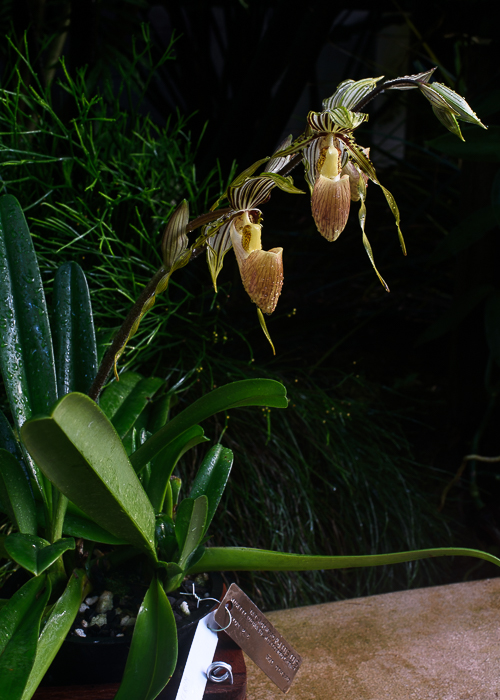
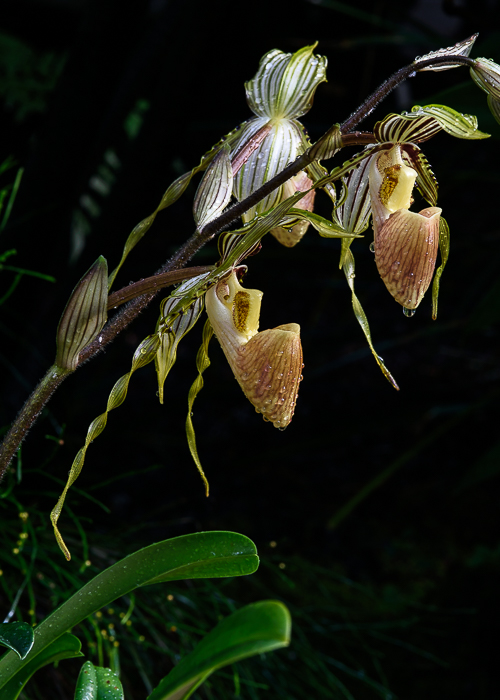
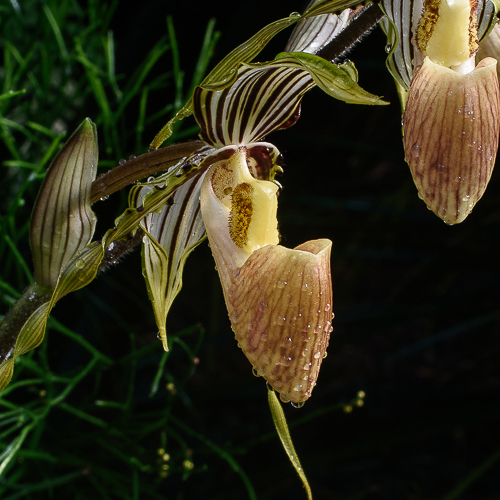
Paphiopedilum glanduliferum
Posted by
Becky Brinkman
Of the Asian slipper orchids in our collection, the species belonging to the section Coryopedilum are among the most striking. They don't have the candy and fruit bowl colors of some of the Chinese or Vietnamese slippers, like delenatii or armeniacum. Instead, these species are regal and impressively big. They are also, at least in our warm climate, the easiest to grow. The eleven Coryopedalum species come from Indonesian and Malaysian islands where they grow at low elevations.
A clutch of them are flowering this month: glanduliferum, kolopakingii and sanderianum.
Sunday, January 8, 2017
Snow Day
Posted by
Becky Brinkman
Atlanta had one of its snowless Snow Days on Friday in which schools, workplaces, and virtually the entire city closed down in order to allow everyone to rush to the grocery for bread, milk and batteries ahead of the impending Snowmageddon! (And, skeptics, we did get a little ice Friday night, so it was totally and completely justified.) So after everyone fled the Garden, I took the opportunity to take some leisurely pictures in the Orchid Display House. It was quiet and lovely in the semi-twilight.
See what you missed? Don't worry, most of these guys will still be in flower next week, plus many more. And don't forget, the Fuqua Orchid Center is one of the best places in town to spend a cold January day.
⚘
See what you missed? Don't worry, most of these guys will still be in flower next week, plus many more. And don't forget, the Fuqua Orchid Center is one of the best places in town to spend a cold January day.
⚘
Wednesday, January 4, 2017
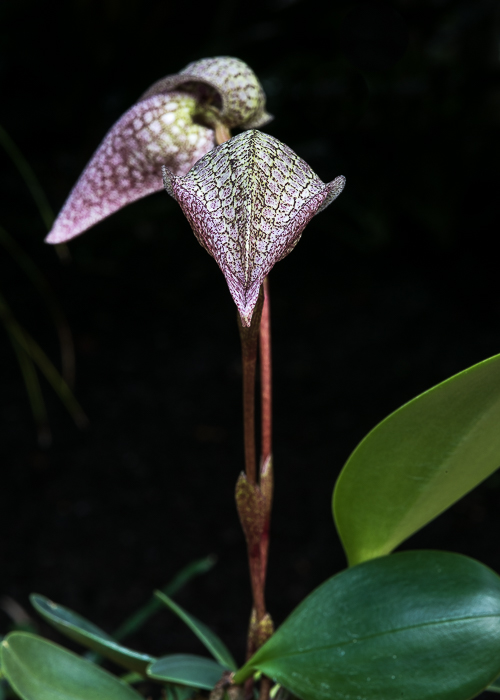
Bulbophyllum arfakianum
Posted by
Becky Brinkman
Bulbophyllum arfakianum unfurled its flowers for the first time last week, and I was felled on the instant. There isn't a single vantage point from which the flower doesn't look ravishing. Bulbophyllum arfakianum is native to West Papua, Indonesia. The specific epithet, arfakianum, references the Arfak Mountains, an outstandingly rich region of biological diversity on the Bird's Head Peninsula. Bulbophyllum arfakianum grows as an epiphyte in lowland forest at 50 to 400 meters elevation.
⚘
Friday, January 16, 2015
Pink Tulip Orchid
Posted by
Becky Brinkman
At first glance, it would be possible to mistake this beautiful plant for Anguloa uniflora, another pink tulip orchid species. But Anguloa virginalis is recognizable by its laterally flattened flowers with pointed petals and sepals.
Front view, showing how narrow the flower of A. virginalis is compared with A. uniflora. Orchid flowers have bilateral symmetry. But like virtually all organisms, this individual defies any expectation of symmetrical perfection. The column is turned slightly left of center, reflecting a twist in the ovary and scape. The two lower sepals meet unevenly. One sepal points slightly leftward. I like these fascinating irregularities.
From the side, you can see the distinctive kink near the base of the tubular lip -a feature that is diagnostic for virginalis.
Ventral view of the lip. From this angle, you can see that the kink in the lip is actually a depression in the ventral surface.
Dorsal view of the lip.
Anguloa virginalis is native to Colombia, Ecuador and Peru, where it grows as a terrestrial or lithophyte at around 2000 meters elevation in bright light. Henry Oakeley reports its habitat as full sun or light woodland and forest margins. Our plants like the cool temperatures (52º night minimum) of our Tropical High Elevation House where they are planted in the ground in a mixture of fine fir bark, charcoal and permatill.
Front view, showing how narrow the flower of A. virginalis is compared with A. uniflora. Orchid flowers have bilateral symmetry. But like virtually all organisms, this individual defies any expectation of symmetrical perfection. The column is turned slightly left of center, reflecting a twist in the ovary and scape. The two lower sepals meet unevenly. One sepal points slightly leftward. I like these fascinating irregularities.
From the side, you can see the distinctive kink near the base of the tubular lip -a feature that is diagnostic for virginalis.
Ventral view of the lip. From this angle, you can see that the kink in the lip is actually a depression in the ventral surface.
Dorsal view of the lip.
Anguloa virginalis is native to Colombia, Ecuador and Peru, where it grows as a terrestrial or lithophyte at around 2000 meters elevation in bright light. Henry Oakeley reports its habitat as full sun or light woodland and forest margins. Our plants like the cool temperatures (52º night minimum) of our Tropical High Elevation House where they are planted in the ground in a mixture of fine fir bark, charcoal and permatill.
Tuesday, January 13, 2015
A Natural Hybrid
Posted by
Becky Brinkman
It was the single orange flower in a sea of yellow tulip orchids that stopped me in my tracks. We don't have many Anguloa x ruckeri in our greenhouse and it was worth stopping for a second look. Anguloa x ruckeri is a naturally occurring hybrid between Anguloa hohenlohii and Anguloa clowesii.
It grows terrestrially at 900 to 2000 meters elevation in Venezuela and is known at least historically from Colombia as well, according to Henry Oakeley in Lycaste, Ida and Anguloa, The Essential Guide (2008).
This individual has inherited an overlay of red spots from its hohenlohii parent. They coalesce into a deep rose colored wash on the interior. After I removed a petal and sepal, the lip (on the left) became visible opposite the column.
The lip is joined to the column by a tiny hinge at the foot of the column. As is typical in anguloas, the column foot is very long -in the photo above it is deep red. The hinge allows the lip to swing toward the column, bumping the bee against the anther cap at the end of the column.
The upper surface of the lip. It is intermediate in shape between Anguloa clowesii and Anguloa hohenlohii.
The underside of the lip.
Oakeley states that Anguloa x ruckeri is reported as growing in the same conditions in the wild as A. clowesii and A. hohenlohii. In cultivation, our plants are growing well in an intermediate greenhouse with 60º night minimum temperature and 70% shade.
It grows terrestrially at 900 to 2000 meters elevation in Venezuela and is known at least historically from Colombia as well, according to Henry Oakeley in Lycaste, Ida and Anguloa, The Essential Guide (2008).
This individual has inherited an overlay of red spots from its hohenlohii parent. They coalesce into a deep rose colored wash on the interior. After I removed a petal and sepal, the lip (on the left) became visible opposite the column.
The lip is joined to the column by a tiny hinge at the foot of the column. As is typical in anguloas, the column foot is very long -in the photo above it is deep red. The hinge allows the lip to swing toward the column, bumping the bee against the anther cap at the end of the column.
The upper surface of the lip. It is intermediate in shape between Anguloa clowesii and Anguloa hohenlohii.
The underside of the lip.
Oakeley states that Anguloa x ruckeri is reported as growing in the same conditions in the wild as A. clowesii and A. hohenlohii. In cultivation, our plants are growing well in an intermediate greenhouse with 60º night minimum temperature and 70% shade.
Monday, January 5, 2015
Winter Tulip Orchids
Posted by
Becky Brinkman
Here to rescue us from January drabness is an welcome burst of winter flowers on three of our Tulip Orchid (Anguloa) taxa: clowesii, virginalis and x ruckeri. It's not very often that we have three different taxa flowering simultaneously, so I thought this would be a good opportunity to take a closer look at each one. They are lovely.
Anguloas have large waxy fragrant flowers that attract male Euglossine bees. This particular Anguloa clowesii has a touch of wintergreen in its fragrance. The genus Anguloa is sometimes called the Cradle Orchid because the flower has a hinged lip. Let's open up a flower and see how that works.
The interior of the flower is easier to see after I remove one petal and one sepal.
The lip of an Anguloa is hinged. It is attached to the column foot by a narrow band that allows the lip to swing back and forth between the sepals and the column. I love plants with moveable parts.
According to N.A. van der Cingel in An Atlas of Orchid Pollination (2001), the male Euglossine bee lands on the lip, turns and backs into the flower. He holds onto the edges of the petals with his middle legs while scratching for fragrance with his front legs. On leaving, he releases its hold on the petals and his weight tips the lip against the column. The pollinarium is attached to his abdomen. I suppose bees are accustomed to holding onto moving surfaces and don't find this trapeze act unnerving.
The lip in dorsal view, a sturdy boat-shaped platform for the bee.
The underside of the lip.
Anguloa clowesii grows as an epiphyte or terrestrial at around 1600 meters elevation in Colombia and Venezuela. In cultivation they are often deciduous, although in our greenhouse they rarely lose all their leaves.
Next: Anguloa x ruckeri.
Anguloas have large waxy fragrant flowers that attract male Euglossine bees. This particular Anguloa clowesii has a touch of wintergreen in its fragrance. The genus Anguloa is sometimes called the Cradle Orchid because the flower has a hinged lip. Let's open up a flower and see how that works.
The interior of the flower is easier to see after I remove one petal and one sepal.
The lip in dorsal view, a sturdy boat-shaped platform for the bee.
Anguloa clowesii grows as an epiphyte or terrestrial at around 1600 meters elevation in Colombia and Venezuela. In cultivation they are often deciduous, although in our greenhouse they rarely lose all their leaves.
Next: Anguloa x ruckeri.
Tuesday, January 28, 2014
My Nominee for Best Common Name
Posted by
Becky Brinkman
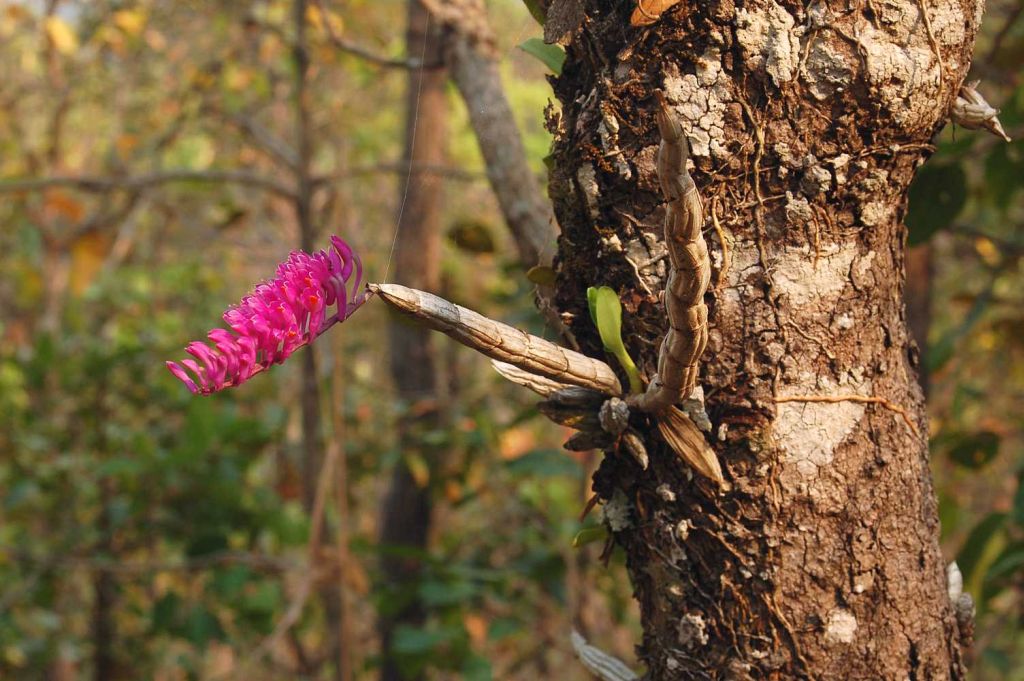
Somebody nailed this one. On Dendrobium secundum, the flower spike appears at the very end of a narrow tapering cane. The flowers are densely packed, like bristles, and all pointing to one side. If I were a Photoshop ace, I would put one of these in a ceramic mug alongside a tube of Crest on my bathroom sink.
Dendrobium secundum is pretty common in cultivation (there are pink and white forms) and widespread in nature. It grows as an epiphyte from sea level to about 700 meters in dry forests in southeast Asia, Borneo, New Guinea and the Philippines.
Since Dendrobium secundum comes from seasonally dry areas, we try to accommodate it with a dry rest in winter. We let it go bone dry and stay that way for a day or two between waterings. It never completely sheds its leaves in winter. It does well in our warm greenhouse (65º night minimum) in 50% shade.
Dendrobium secundum is pretty common in cultivation (there are pink and white forms) and widespread in nature. It grows as an epiphyte from sea level to about 700 meters in dry forests in southeast Asia, Borneo, New Guinea and the Philippines.
Since Dendrobium secundum comes from seasonally dry areas, we try to accommodate it with a dry rest in winter. We let it go bone dry and stay that way for a day or two between waterings. It never completely sheds its leaves in winter. It does well in our warm greenhouse (65º night minimum) in 50% shade.
Wednesday, February 20, 2013
They're fuzzy. You can pet them.
Posted by
Becky Brinkman
A lot of horticulturists, especially those of us at botanical gardens and zoos, despair that visitors generally prefer cute furry animals to our own awesomely cuter plants. 'They asked to see the panda and walked right past my Canna Lily!' The rest of us simply cave. In fact, I have a hunch that most botanists and horticulturists are closet zoologists. You know the type. The plant geek who has at home a conifer arboretum, pitcher plant bogs, four rescue dogs, a cat, thirty seven tortoises and a litter of bottle-fed baby possums. And I understand completely.
But allow me to make a photographic argument for the awesomeness of plants that are furry. I'm talking about plants that are hairy, tomentose, pubescent, villose or hirsute. Like Dendrobium macrophyllum with its faux fur sepals, ovary and pedicel.
Dendrobium macrophyllum grows as an epiphyte from sea level to 1700 meters in New Guinea. It is widespread from Java, the Philippines, through New Guinea, the Solomon Islands, New Caledonia, Vanuatu, Fiji and Samoa. It's reported to be one of the biggest orchid epiphytes in the forest canopy.
What are they for, these epidermal hairs (aka trichomes)? Hairs on leaves serve a variety of purposes --they slow water loss, reflect solar radiation (succulents), provide a layer of frost protection (Puya), are water absorbant (Tillandsia), provide chemical defense or entrapment (glandular hairs on lots of species). Could the hairs on the sepals of Dendrobium macrophyllum make the buds less enticing to a hungry herbivore? Maybe. But they definitely make the orchid appealing to us.
But allow me to make a photographic argument for the awesomeness of plants that are furry. I'm talking about plants that are hairy, tomentose, pubescent, villose or hirsute. Like Dendrobium macrophyllum with its faux fur sepals, ovary and pedicel.
Dendrobium macrophyllum grows as an epiphyte from sea level to 1700 meters in New Guinea. It is widespread from Java, the Philippines, through New Guinea, the Solomon Islands, New Caledonia, Vanuatu, Fiji and Samoa. It's reported to be one of the biggest orchid epiphytes in the forest canopy.
What are they for, these epidermal hairs (aka trichomes)? Hairs on leaves serve a variety of purposes --they slow water loss, reflect solar radiation (succulents), provide a layer of frost protection (Puya), are water absorbant (Tillandsia), provide chemical defense or entrapment (glandular hairs on lots of species). Could the hairs on the sepals of Dendrobium macrophyllum make the buds less enticing to a hungry herbivore? Maybe. But they definitely make the orchid appealing to us.
Monday, January 28, 2013
Dendrobium spectabile
Posted by
Becky Brinkman
This is so exciting. I just can't wait to show you this orchid. Every year I wait for it. And it never disappoints.
Dendrobium spectabile. Who can resist this pack of demons? Each flower has a pair of twisted horns (petals and sepals) and a hinged lip that pulls forward like an enormous gaping jaw.
Dendrobium spectabile grows mainly as an epiphyte in tree canopies in the hot humid lowlands of New Guinea and the Solomon Islands.
And check out the back of the flower, always neglected territory. Look at the undulating margins. What an extraordinary plant!
Dendrobium spectabile. Who can resist this pack of demons? Each flower has a pair of twisted horns (petals and sepals) and a hinged lip that pulls forward like an enormous gaping jaw.
Dendrobium spectabile grows mainly as an epiphyte in tree canopies in the hot humid lowlands of New Guinea and the Solomon Islands.
And check out the back of the flower, always neglected territory. Look at the undulating margins. What an extraordinary plant!